

If you have been researching outdoor play structures and keep seeing the word “modular,” you are not alone in wondering what that actually means in practice. A modular swingset is not just a marketing term for a slightly bigger kit. It is a fundamentally different approach to how a play structure is designed, built, and used over time. Understanding the difference can save your family from an expensive mistake and help you invest in something your kids will still love a decade from now.
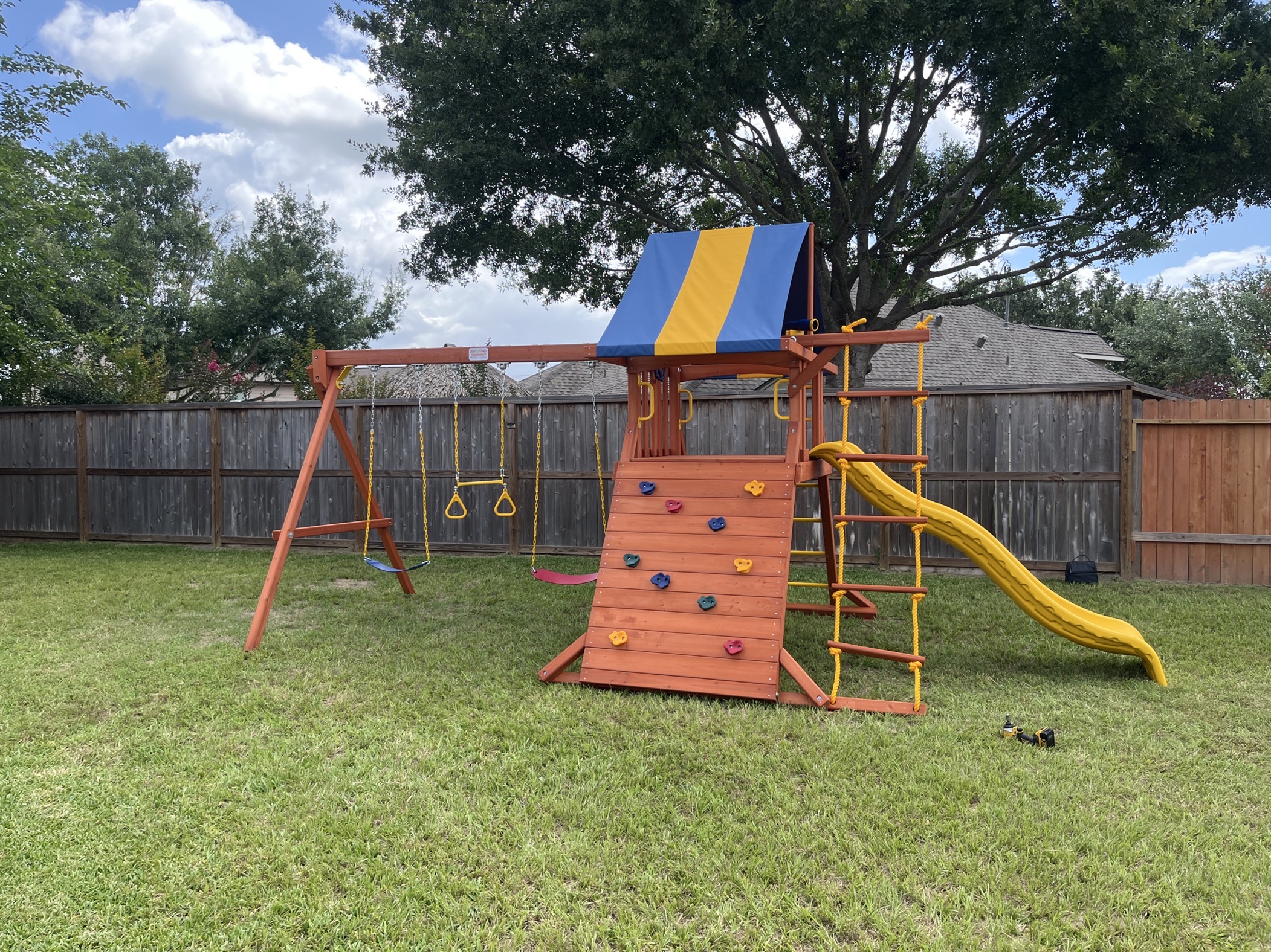
A modular swingset is a play structure built on a configurable base system where individual components such as forts, slides, rock walls, swings, and deck levels can be added, rearranged, or upgraded over time. Instead of being locked into a single fixed configuration at purchase, the structure is designed from the start to evolve.
The contrast with a static, fixed-configuration playset is straightforward. When you buy a fixed set, what you see on the box is what you get for the entire life of the structure. When you buy a modular system, what you see at purchase is just the starting point.
For families, this difference in purchasing philosophy has a real financial implication. A modular system purchased when children are two or three years old can still be a genuinely engaging, age-appropriate structure when those same kids are ten or eleven. The grow-with-my-family architecture built into every Tree Frogs Swingsets structure means parents can start with a baseline configuration and add forts, rock walls, slides, and tire swings over time rather than replacing an outgrown playset every few years.
Most parents have never seen a truly modular swingset up close, and that makes the concept harder to evaluate than it should be. The mechanics are worth understanding because they are what make the long-term value story possible.
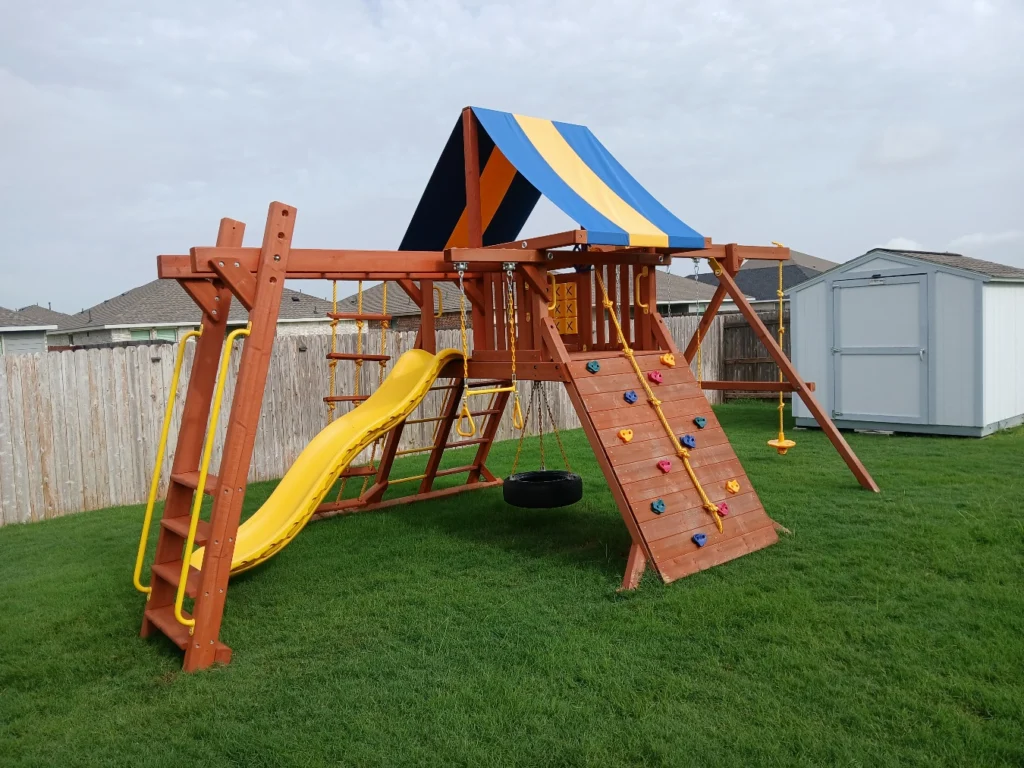
Tree Frogs Swingsets builds around two primary base system types: fort-base systems and ladder-base systems. A fort-base system centers on an elevated platform or fort structure, giving children a defined home base with enclosed or partially enclosed walls, a deck, and built-in attachment points for accessories. A ladder-base system uses a more open frame structure that accesses upper levels via a straight or angled ladder rather than a climbing wall. Both serve as the foundation for everything that comes after.
The expansion pathway is where the modular story becomes most compelling for parents. In the toddler years, from about ages two through five, a starter fort with a basic slide and a set of belt swings gives young children everything they need. As kids grow stronger and bolder around ages five to seven, a rock wall and rope ladder make the structure feel new again without touching the base frame. In the seven-to-ten range, a secondary deck level or a larger, faster slide raises the physical challenge. By the time peer-group play matters most, tire swings, trapeze bars, and snack bars turn the backyard into a social destination.
None of those additions require a rebuild. They attach to the existing structural members of the base frame using heavy-duty through-bolt construction rather than plastic connector clips or snap-together hardware. The base posts remain in the ground, the primary frame stays intact, and the structure gains new capability one component at a time.
The material choice is inseparable from this. Tree Frogs Swingsets builds with 100% premium Pacific Northwest Redwood and Western Red Cedar, two timber species with natural oil content that makes them resistant to insects, rot, and structural warping. That natural durability is not incidental to the modular concept. A structure that begins to degrade in three or four years defeats the entire purpose of buying modular. When the base is built from timber engineered to outlast a decade of outdoor exposure, adding to it over time actually makes sense.

Parents who are weighing a premium modular structure against a mass-market fixed set are really making two different decisions at once: what to buy today, and what they will need to buy again in three or four years. Looking at both decisions together changes the math considerably.
Lifespan of relevance is the most important difference. Static playsets sold at mass-market retailers are typically relevant for two to four years before children physically and developmentally outgrow them. A well-built modular system is designed to remain relevant for ten or more years through component additions that match where each child is in their development.
Material quality is the second major contrast. Mass-market sets frequently use chemically-treated softwoods or plastic components that crack, fade, and degrade under prolonged heat and UV exposure. Premium modular systems built from natural redwood and cedar use timber from certified mills and sustained-yield forest management programs, producing chemical-free natural lumber that holds up in ways pressure-treated wood and plastic simply cannot.
A third difference is relocation and resale value. A modular wood structure can be disassembled and relocated to a new home or upgraded by a future owner. Flat-pack plastic sets have no meaningful resale value and no reasonable path to relocation.
The total cost of ownership argument follows from all three. The upfront investment in a premium modular set is higher than a big-box alternative. But when you account for the longer useful lifespan and the ability to add rather than replace, the cost spread across years of actual use often tells a different story. Families who buy a fixed mass-market set and then replace it two cycles later have frequently spent more in total than a single modular purchase would have cost.
One of the most practical questions a parent can ask before buying a modular system is: what exactly can be added later, and will it still fit when the kids are older? The accessory ecosystem around a modular swingset is what makes the long-term value real rather than theoretical.
Tree Frogs Swingsets offers add-on components that attach to the existing base structure without requiring a rebuild. Here is a look at the major categories and who they are best suited for:
Rock walls build hand and grip strength and are appropriate from ages three or four and up. They are one of the most popular first additions because they give young children a new physical challenge without changing the footprint of the structure.
Slides come in several configurations, including standard straight slides, scoop slides, spiral slides, and double-wall designs. The speed and physical thrill scale naturally with age, so a toddler-appropriate slide can eventually be swapped for something more exciting as kids grow.
Tire swings and rope swings introduce multi-child social play in a way that belt swings alone do not. They are particularly popular in the five-to-ten age range when kids start playing in groups.
Fort decks and secondary deck levels expand vertical play space and give older children a genuine sense of height and independence. A second deck also opens up new attachment points for accessories.
Treehouse panels and snack bars shift the structure toward imaginative play and social gathering, both of which become central to play between ages seven and twelve.
Trapeze bars and gymnastics-style attachments appeal to children who are developing upper-body strength and enjoy physical challenge.
Belt swings and glider swings remain classics throughout childhood and can be added or expanded in number as the structure grows.
Every one of these components is intentionally designed to build off of the existing base structure. The modularity is not an afterthought. It is the architecture.

A premium modular swingset built from natural redwood or cedar and properly maintained can last a decade or more. That lifespan is not an estimate based on optimistic conditions. It reflects the material science behind the timber itself.
Redwood and cedar contain natural oils that resist rot, insects, and UV degradation without any chemical treatment. These are not softwoods that need to be pressure-treated to survive outdoor conditions. They are naturally engineered for it. Where chemically-treated lumber and plastic components degrade under extended heat and sun exposure, redwood and cedar hold their structural integrity through years of all-weather use.
The primary maintenance requirements for a wooden swingset are straightforward: annual re-staining to refresh the wood’s surface protection, periodic hardware checks to confirm everything is tight, and occasional component inspection for any wear that warrants replacement. These are not burdensome tasks, and Tree Frogs Swingsets offers professional re-staining and long-term safety maintenance services for families who would rather have the same team handle it.
The short answer is that professional installation is not technically required, but it is the single most important factor in how safe and how long-lasting a swingset ends up being. The distinction matters more than most parents realize when they are comparing options.
What professional installation actually involves goes well beyond assembly. The process begins with a yard assessment: evaluating slope, soil composition, and drainage to determine the right base approach. For flat, firm ground, concrete-anchored base posts provide the foundation. For sloped or uneven terrain, that assessment drives a grading and leveling plan before installation begins. From there, the base posts are set in concrete, the structure is assembled to torque specification, and a final safety inspection confirms everything is stable before children use it.
Tree Frogs Swingsets includes professional installation as part of the purchase process, not as a separate upsell. The in-house team handles yard-leveling, concrete anchoring, full assembly, and the final safety check as a complete concierge experience from showroom to backyard.
A modular swingset is a play structure built on a configurable base system, typically a fort or ladder platform, that can be expanded over time by adding components such as slides, rock walls, swings, fort decks, and treehouse panels. Unlike fixed-configuration playsets, a modular system is designed so that parents can start with a starter setup when children are young and add new elements as kids grow older and their play needs change. Tree Frogs Swingsets builds every structure on this modular architecture, using heavy-duty redwood and cedar framing with through-bolt construction that supports additions for a decade or more.
Yes, and this is the core purpose of a modular wooden swingset. Modular systems are designed so that accessory components attach to the existing structural base without requiring a rebuild or significant modification to the original installation. Common additions include rock walls, larger slides, tire swings, secondary fort decks, trapeze bars, and treehouse panels, each of which attaches to the existing timber framing. Tree Frogs Swingsets structures use heavy-duty through-bolt construction and recessed hardware specifically so that the base frame can support these additions over years of use without compromising structural integrity.
A premium modular swingset built from natural redwood or cedar and properly maintained can last a decade or more. Redwood and cedar contain natural oils that resist rot, insects, and UV degradation better than chemically-treated softwoods or plastic alternatives, making them well suited for extended outdoor exposure in all climates. Annual re-staining and periodic hardware checks are the primary maintenance requirements. Tree Frogs Swingsets also offers professional re-staining and long-term safety maintenance services for families who want ongoing support from the same team that installed their structure.
A regular or static swingset is built in a single fixed configuration. What you purchase is what the structure will be for its entire life. A modular swingset is built on a base system designed from the start to accept additional components over time, meaning the structure can evolve as children grow rather than becoming irrelevant when they age past the original configuration. A modular set purchased for a two-year-old can still be a relevant, age-appropriate structure for a ten-year-old through strategic accessory additions. Tree Frogs Swingsets’ grow-with-my-family architecture is built specifically around this idea, so families are not replacing an outgrown playset every three or four years.
For families with young children who plan to be in their home for several years, a modular swingset is typically a better long-term value than a static mass-market set. The higher purchase price is offset by a useful lifespan that extends a decade or more, along with the ability to add components rather than replace the entire structure as children grow. The cost spread across years of actual use is frequently lower than the combined cost of purchasing and replacing a fixed big-box set two or more times. Tree Frogs Swingsets structures are built from 100% premium Pacific Northwest Redwood and Western Red Cedar, materials that hold their structural integrity in ways cheaper alternatives cannot, which is what makes that long-term value calculation realistic rather than aspirational.
When you are ready to see what a modular swingset actually looks and feels like in person, Tree Frogs Swingsets Texas showrooms are where families come to climb, test, and ask every question before making a decision. If you are outside Texas, our team is available to walk you through configuration options and connect you with a local installer in your area. Browse our fort-base systems to start exploring what your backyard could look like, and reach out to the team when you are ready to talk through what makes sense for your family.